
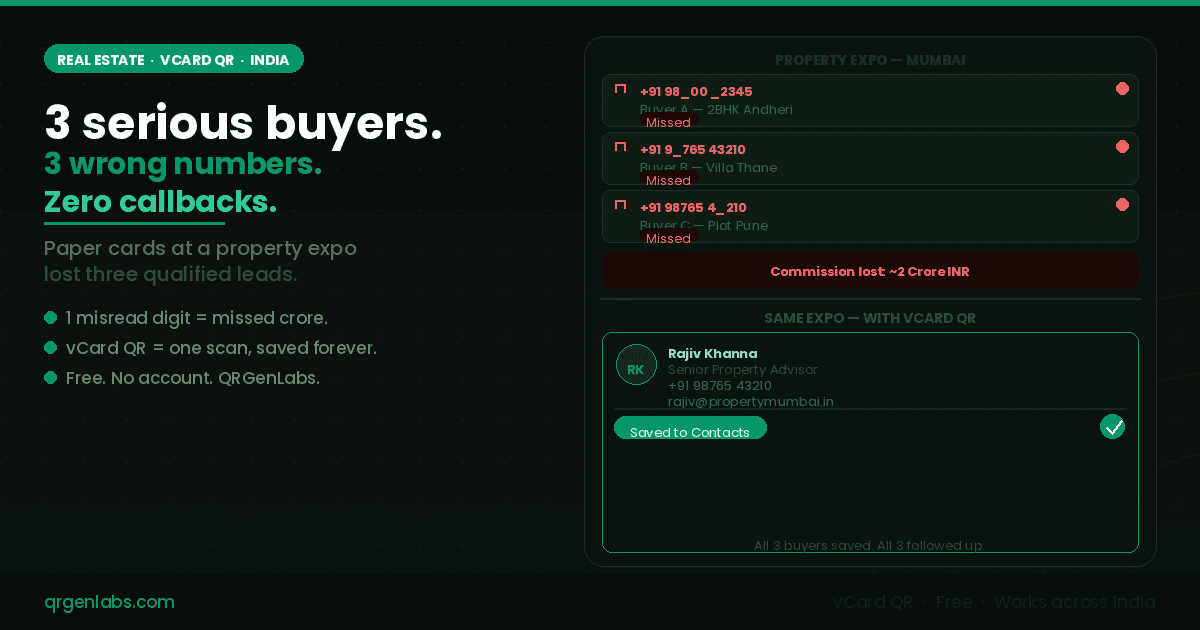
Rajiv Khanna spent two days at a property expo in Mumbai. He met hundreds of prospective buyers, handed out over three hundred visiting cards, and had meaningful conversations with at least forty people who showed genuine interest.
Three of those forty were serious. A family looking for a 2BHK in Andheri. A software professional interested in a villa plot in Thane. A Pune-based NRI wanting to invest in residential property in the city.
All three tried to call him in the days after the expo. All three got his number wrong by one digit — transposed from his printed card. All three got a disconnected line or a stranger. None of them called back a second time.
Rajiv never knew any of this happened. His phone did not ring. He assumed the leads went cold on their own. He moved on.
This is the invisible cost of the paper visiting card in Indian real estate. And it is happening every single day at every property expo, site visit, and broker networking event across India.
The property expo lead problem nobody measures
India's real estate sector runs on relationships. Whether you are a broker in Bandra, a developer's sales executive in Gurgaon, or a property consultant in Whitefield Bangalore — your ability to follow up after a meeting depends entirely on whether the contact information you exchanged was transferred correctly.
At a busy property expo — Think Maharashtra Housing Exhibition, Credai property fairs, JLL India events, Knight Frank India launches, or any of the hundreds of city-level expos happening in metros from Chennai to Ahmedabad — a serious agent distributes anywhere from two hundred to five hundred visiting cards over two to three days.
The problem begins the moment the expo ends.
Buyers take your card home, find it in a pocket two days later, and try to type your number into their phone. A ten-digit Indian mobile number has no natural breaks for most buyers to use as memory anchors. One wrong digit — 98765 typed as 98756, for instance — and the call goes nowhere.
Your email address is worse. If your domain is a company handle — something like rajiv@propertymumbai.in or leads@bhavishyaproperties.com — one wrong letter in the domain, one missed dot, one extra character, and the message bounces silently. You never receive it. You never know it was sent. The buyer assumes you are unresponsive and moves on to the next agent they met.
In a market where a single residential property sale in Mumbai's western suburbs can generate a commission of eight to fifteen lakh rupees, and a premium property in Powai or Worli can put twenty-five to forty lakh in commission on the table, this is not a minor inconvenience. This is a structural revenue leak that most agents do not track because they never see the failed contact attempts.
Why Indian professionals are especially exposed to this problem
The Indian business context makes this problem more acute than in many other markets, for several specific reasons.
Mobile numbers are ten digits with no standard formatting. Unlike countries where numbers are grouped with consistent separators, Indian mobile numbers are often written differently by different people — 9876543210 vs 98765 43210 vs +91-98765-43210. A buyer trying to save your number from a card has to get all ten digits right with no visual anchor to help them catch an error.
Email domains vary wildly. Many Indian professionals use custom business domains rather than Gmail or Outlook, which buyers recognise by sight. When someone tries to type rajiv.khanna@bhavishyainfrastructure.in from a small printed card, the chance of a typo in a long company domain is significant.
Visiting cards are exchanged in volume at high-density events. A buyer at a three-day property expo collects cards from thirty to fifty agents, developers, and brokers. By the time they get home, they cannot always remember which card belongs to which conversation. The ones they most wanted to call are mixed in with the ones they took out of politeness.
Follow-up windows are short. In Indian real estate, a buyer who does not hear from you within three to five days of a meeting typically moves to the next option. The market is competitive enough that the gap created by one failed contact attempt is quickly filled by a competitor who happened to hand their number over more reliably.
What a vCard QR code does differently
A vCard QR code encodes your complete professional contact details — name, designation, company, mobile number, email address, website, and any additional fields — directly into a scannable QR matrix using the RFC 6350 VCF standard.
When a buyer or fellow broker points their phone camera at it — any Android phone, any iPhone, no app download required — the native contacts application opens immediately with every field already populated. Name spelled correctly. Mobile number exact. Email address character-perfect. They tap save. Your contact is in their phone.
The entire process takes three seconds. It requires no typing, no reading small print, no manually entering data from a card days after a busy expo. The contact transfers from your QR code to their address book in a single camera gesture.
There is no version of this that produces a wrong number. There is no way to misread an email address that was never typed. The error rate is zero because there is no manual step at which an error can occur.
The same expo, different outcome
Run the Mumbai property expo scenario again — same Rajiv, same three serious buyers — but this time his visiting card has a vCard QR code printed on the back.
The family looking at Andheri properties does not pocket the card and forget about it. They scan the QR at the end of the conversation, while Rajiv is still standing in front of them. His contact saves to their phone in three seconds. They call him the next morning with their site visit availability.
The Thane villa buyer scans the QR on the train home from the expo. The contact is in his phone by the time he reaches Thane station. He WhatsApps Rajiv that evening.
The Pune NRI scans the QR right at the booth because her friend told her to always do this at expos. She emails Rajiv from her phone before leaving the venue.
All three contacts were saved correctly. All three follow-ups happened. The commission that was invisible — because the leads never came back — becomes real revenue.
The only difference between the two outcomes is a QR code on the back of a visiting card.
Where Indian professionals are placing vCard QR codes
The property expo use case is the most dramatic, but Indian professionals across sectors are using vCard QR codes in contexts that directly address the contact loss problem.
On visiting cards and business cards. The most obvious placement — print the QR on the back of your existing card. Buyers who want to type your number can still do so. Buyers who know to scan can do that instead. Both audiences served with one print run.
On property brochures and site visit booklets. Property developers and sales teams in Bengaluru, Hyderabad, Noida, and Pune are printing agent vCard QRs on the back page of site brochures. Buyers who take a brochure home have a permanent scan point for the agent's contact, long after the original card has been lost.
On standee banners at property events. A large-format vCard QR on your expo standee means every person who walks past and photographs your booth — which buyers do routinely to remember which properties they saw — also captures your contact in the scan.
In WhatsApp and email signatures. Indian professionals communicate heavily through WhatsApp. A vCard QR in your WhatsApp status or email signature means any contact who wants to save your number correctly can scan it directly rather than typing from a chat.
On site visit name badges. For developers hosting site visit days in projects across Navi Mumbai, Whitefield, Gachibowli, and similar high-activity corridors, printing agent vCard QRs on name badges means every buyer who interacts with an agent at the site has an immediate, frictionless way to save that agent's details before leaving the property.
Static vCard QR versus Dynamic vCard QR — what to use when
QRGenLabs generates both. The distinction matters for Indian professionals thinking about print volume and update frequency.
A static vCard QR encodes your contact details directly into the physical QR matrix. It works offline, requires no server, and lasts indefinitely — the information survives as long as the printed material does. It is free forever on QRGenLabs with no account required. Use this if your mobile number, email, and designation are stable. Print it on visiting cards, brochures, and any material that will be used over a consistent period.
A dynamic vCard QR points to a hosted contact profile. It lets you update your phone number, email, or company name after the QR has already been printed — without reprinting anything. It also tracks scan analytics: how many scans, from which city, at what time. For real estate professionals who change agencies, get a new company number, or want to track which marketing materials are generating the most contact saves, the dynamic option is the right tool.
Important for static codes: Keep your encoded fields minimal. Name, one mobile number, one email, one website URL. Adding multiple phone numbers, extensive social profiles, and long company addresses increases QR density significantly — making it harder to scan on matte brochure paper under the fluorescent lighting of a property expo venue. For comprehensive contact profiles, use the dynamic option.
How to create your vCard QR code on QRGenLabs
Creating a vCard QR code on QRGenLabs takes under sixty seconds and requires no account for a static code.
- Go to QRGenLabs and select the vCard QR type from the generator
- Enter your contact details — name, designation, company, mobile number, email address, and website
- Customise the design — add your company logo, choose your brand colours, set the error correction level to High for printed material
- Test scan with your phone to confirm the contact save prompt appears correctly before exporting
- Export as PNG for digital use or SVG for print-quality output — hand the SVG directly to your printing vendor for visiting cards and brochures
Static vCard QR codes are free forever on QRGenLabs — no account required, no expiry, no watermark to remove before your print run.
The contact you worked to earn should not disappear on the way to their phone
The leads you build at a property expo, a networking event, or a site visit day represent hours of preparation and real professional effort. The paper visiting card — despite being a century-old standard — introduces a manual transcription step at the end of every interaction that silently destroys a measurable percentage of the contacts you work to build.
In a market as competitive as Indian real estate — whether you are working residential projects in Mumbai, commercial space in Bengaluru, plotted development in Hyderabad, or affordable housing in Pune — the margin between following up successfully and losing a buyer to a misread digit is the difference between a commission and a missed month.
A vCard QR code closes that gap permanently. One scan. Full contact. Saved correctly. Every time.
Create your free vCard QR code at QRGenLabs — no account, no expiry, ready to print before your next expo.