
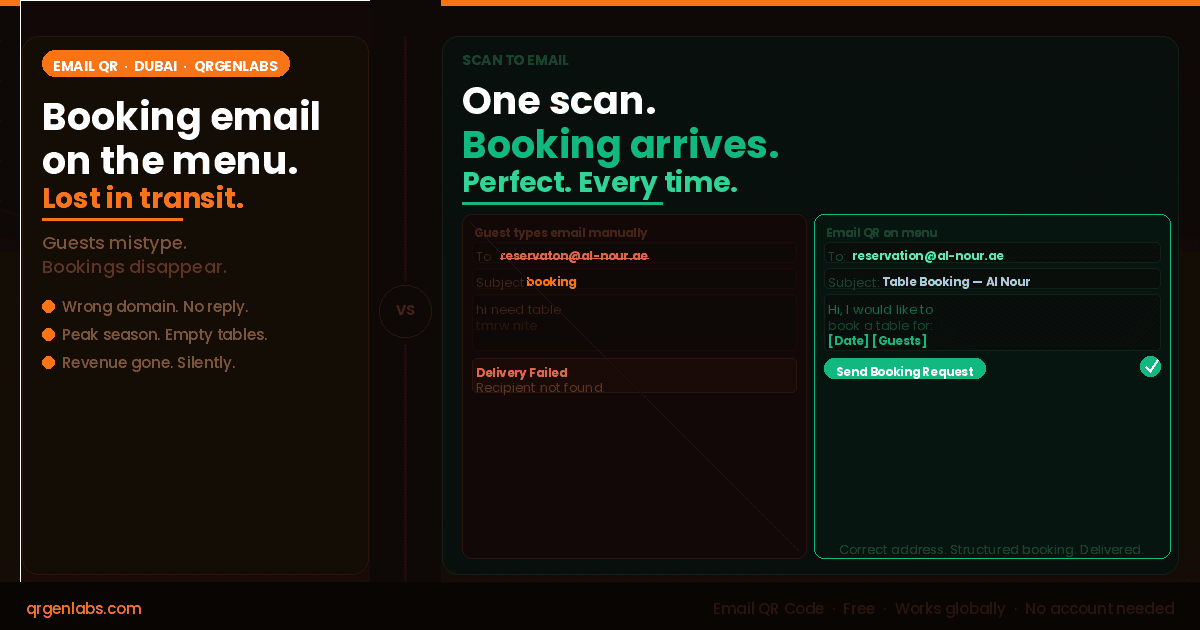
The dinner rush starts at eight. By six-thirty, the reservation inbox at Al Nour Restaurant in Dubai Marina has three new messages.
One arrived from a guest who typed the wrong domain — reservation@ instead of reservations@ — so the email bounced back to them silently. They assumed the restaurant was fully booked and called a competitor down the road.
One arrived with a subject line that read "hi". The body said "table tmrw nite". The restaurant manager had no idea how many people, no idea what time, no idea if they meant indoor or terrace. By the time they replied asking for details, the guest had already made other plans.
One arrived correctly — sent, delivered, structured. That booking was confirmed.
Of the three guests who genuinely wanted to book, one completed the process. Two were lost to friction that had nothing to do with availability, pricing, or experience.
This is what happens when a hospitality business puts an email address on a printed menu and trusts guests to type it correctly, write a clear subject line, and include all the relevant details — in a busy restaurant, from a small screen, under ambient lighting, after one or two drinks.
The invisible booking loss problem in hospitality
The restaurant industry is one of the most competitive businesses on the planet. Margins are thin. Every cover matters. Every peak-season weekend slot has real monetary value.
In Dubai alone, the F&B sector employs over 200,000 people and generates billions of dirhams in annual revenue. The city's restaurant scene — from Downtown Dubai and DIFC to JBR, Business Bay, and Palm Jumeirah — runs at capacity during the October to April high season. A missed booking during peak season is not a minor inconvenience. It is a measurable revenue loss in a sector that cannot afford many of them.
The same problem plays out across hospitality markets worldwide. In London's Soho, where a weekend table at a mid-range restaurant represents £80 to £150 in revenue. In Singapore's Clarke Quay and Orchard Road, where corporate bookings for client dinners hinge on a single reply arriving in the right inbox. In Mumbai's Bandra Kurla Complex, where food-and-beverage venues handling corporate and wedding bookings lose a disproportionate share of enquiries to misdirected emails that never arrive.
Across all of these markets, the root cause is the same: businesses print email addresses on menus, window stickers, event flyers, and table cards — and expect guests to type them correctly under real-world conditions.
Why guests cannot type your booking email reliably
A hospitality email address looks simple from the inside. You know it by heart. You have typed it thousands of times. But from a guest's perspective, sitting at a table, reading a menu footer in candlelight, typing on a phone keyboard:
- They misread a character in the domain. Your domain is
.aeand they type.com. Your address isreservations@and they typereservation@. One letter. Gone. - They do not know what subject line to write. They put "booking" or "hi" and the message arrives in your inbox with no actionable context. Your team has to reply asking for the date, the time, the number of guests, and whether they have any dietary requirements — a back-and-forth that takes hours and sometimes results in the guest giving up.
- They send the message and hear nothing because the bounce notification went to their spam folder. They believe you received and ignored their email. They leave a review mentioning poor communication.
- They simply decide it is too much effort and move on to a restaurant with an online booking widget.
In each of these scenarios, the restaurant did nothing wrong. The food is excellent. The service is warm. The availability is real. The booking was lost entirely because the email address was too fragile a communication tool for that moment of intent.
"In competitive hospitality markets like Dubai, London, Singapore, and Mumbai, the window between a guest deciding to make a booking and acting on that decision is less than ninety seconds. Any friction in that window — wrong address, vague email, no reply confirmation — loses the booking permanently."
What an Email QR code does for hospitality businesses
An Email QR code encodes a complete mailto: URI — defined by internet standard RFC 6068 — into a scannable QR matrix printed on your menu, table card, or window sticker.
When a guest points their phone camera at it, their native mail application opens immediately. The recipient address is already filled in — exactly as you defined it, with no possibility of a typo. The subject line is pre-written — "Table Booking — Al Nour Restaurant" or whatever format your team uses for triage. The message body contains a structured template: date, number of guests, time preference, special requests.
The guest adds their specific details to the template and taps send. The reservation arrives in your inbox as a complete, actionable, correctly-addressed booking request — without a single character of your email address being typed by anyone.
The difference between the three booking scenarios at the start of this post collapses to a single outcome: all three bookings arrive, all three are confirmed, all three guests are seated.
The real-world difference: a week in peak season
Consider what the booking loss problem costs a mid-range Dubai restaurant concretely during peak season.
The restaurant has sixty covers. Average spend per cover is AED 180. During peak season — October through March — they operate at near capacity on weekends. A conservative estimate of missed bookings due to email friction: five to eight per weekend, based on the percentage of guests who attempt to make a booking via the printed email and either fail or receive no structured response.
At five missed bookings per weekend, with an average group size of three, that is fifteen covers per weekend. At AED 180 per cover, that is AED 2,700 per weekend in lost revenue — directly attributable to a printed email address that guests could not use effectively.
Over a twenty-four week peak season: AED 64,800 in lost revenue. From email friction.
The Email QR code on a menu insert or table card costs nothing on QRGenLabs. The print cost of adding it to a menu reprint or table tent is negligible. The ROI calculation is not complicated.
Where hospitality businesses are placing Email QR codes
On the printed menu
The highest-intent placement. A guest reading the menu is already thinking about food, experience, and whether they want to return. A QR code in the menu footer — "Make a reservation" — captures that intent at the exact right moment without requiring them to type anything.
On window stickers and entrance boards
Passers-by who want to book for a future date can scan before entering. The booking request arrives structured, with your restaurant's name in the subject line, before they have even sat down.
On table cards and table tents
For guests already in the restaurant who want to make a future reservation — birthdays, anniversaries, corporate dinners — a table card QR code means they book while they are in the best possible mood to do so. Satisfaction at the table is the strongest booking trigger that exists.
On event flyers and promotional materials
Restaurants in Dubai, Singapore, Mumbai, and London that run themed nights, brunches, and private dining events distribute flyers. A QR code on the flyer pre-fills a subject line like "Private Dining Enquiry — Friday Brunch" and a body template that asks for group size and dietary requirements. Every enquiry arrives structured.
On digital menus and Instagram bio links
An Email QR code embedded in a digital menu PDF or linked from an Instagram profile means guests who discover you online can initiate a booking email from their phone without copying or typing your address. The mailto: link behaves identically to the QR on mobile browsers.
Beyond restaurants: hospitality businesses where Email QR applies
The booking email problem is not unique to restaurants. It exists across the hospitality sector anywhere printed materials contain an email address that guests or clients are expected to use.
Hotels in Dubai, Maldives, Bali, and Singapore that accept email enquiries for suite upgrades, restaurant reservations, and spa bookings lose a percentage of those enquiries to typos in complex hotel domain addresses. An Email QR on the in-room compendium, the restaurant menu, and the spa brochure pre-fills the address and structures the enquiry.
Event venues in London, New York, and Mumbai that receive corporate booking enquiries via printed materials benefit immediately from pre-filled subject lines that identify the event type and approximate date — giving their sales team instant triage context rather than a generic "enquiry" message.
Boutique B&Bs and guesthouses in Tuscany, Rajasthan, and Provence that rely on email for direct bookings rather than OTA platforms can embed Email QR codes in their printed welcome cards, local recommendation guides, and guest books — making it frictionless for guests to recommend the property to friends and family via a pre-filled referral email.
Tour operators in Cape Town, Queenstown, and Kochi that use email as a primary enquiry channel can print Email QR codes on brochures distributed at hotels, airports, and visitor centres — pre-filling the tour type, departure location, and group size template.
Static vs Dynamic Email QR — what hospitality businesses need to know
QRGenLabs generates both. The practical difference matters for hospitality operations with seasonal or departmental routing needs.
A static Email QR encodes the complete mailto: URI directly into the QR matrix. It is offline, serverless, and free forever on QRGenLabs with no account required. The recipient address, subject line, and body template are fixed at generation time. This is the right choice for stable booking addresses on printed materials with a defined lifespan — seasonal menus, annual event flyers, and printed table cards that are replaced on a schedule.
A dynamic Email QR routes through a hosted short link, meaning you can update the recipient address, subject line template, or body text at any point after printing — without reprinting the QR itself. It also provides scan analytics: how many guests scanned the code, from which location, at what time of day. This is the right choice for high-volume print runs where the routing may change — a restaurant that rotates reservation teams seasonally, a hotel that wants to redirect F&B bookings to a new inbox, or a venue group that wants to track which printed materials are generating the most booking enquiries across multiple properties.
How to create your Email QR code on QRGenLabs
Creating an Email QR code on QRGenLabs takes under sixty seconds for a static code and requires no account.
- Go to QRGenLabs and select the Email QR type from the generator
- Enter your reservation or booking email address exactly as guests should reach you
- Write a structured subject line — for example: "Table Booking — [Your Restaurant Name]" or "Reservation Enquiry — [Date]"
- Add a body template — start with "Hi, I would like to book a table for:" followed by placeholder prompts for date, time, and number of guests
- Customise the QR design — add your restaurant logo, use your brand colours, set error correction to High for print
- Export as PNG for digital menus and social media, or SVG for print-quality output on menus, table cards, and window stickers
Static Email QR codes are free forever on QRGenLabs — no account, no expiry, no watermark to remove before your print run.
The booking you almost received should actually arrive
Every guest who scanned your menu QR, typed your address, made a typo, and received a bounce notification was a cover you had, briefly, and then lost. Every guest who sent a vague "hi" email and never heard back was a person who wanted to eat at your restaurant and left feeling ignored.
The email address on your menu is not the problem. The act of typing it is the problem. An Email QR code removes the typing entirely — and with it, every error, every bounce, every lost booking that never showed up in your inbox because it never arrived.
Create your free Email QR code at QRGenLabs — no account, no expiry, ready to add to your next menu reprint.